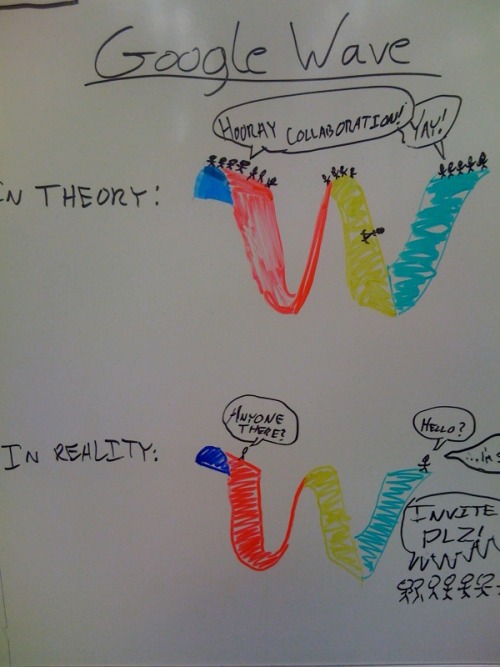
Perry was great enough to send me out an invite to Google Wave yesterday. I got really excited to test it out, but not sure what there is to test out really!
He spoke of was, when, where and how, and all pretty generally. To be expected really.
We went to an OAND sponsored event with well over a thousand people in the seats, closed circuit tv, the works. (Apparently they have changed their website since - perhaps because there was no reference of/for naturopathic doctors in David's talk?) Anyway, he mentioned a lot of things..
David said that even if we turned around our look at the environment, it was too late. For example, if the Canadian government made the environment (like Sweden? - $150+ per CO2 ton emission) its primary policy objective before the 'eco'nomy, he feels, as others, that it's too late for the environment. Anyway, too late for the human race in realistic sustainability terms. David generally brought up coast lines, with Canada having the longest coast lines of any nation. I know this is way too general here and also way too lacks, but this isn't a post about that. Most certainly later. I've learned to do a bit more research before shooting my mouth off...
I had the opportunity to talk about this over dinner on Saturday with Sarah at Cladams' which by anyone's standard was phantasmagoric. I really just wanted an opportunity to post this:
Umm.. actually, the reason for the post was this article. It has to do with scientist's ranking within the science community.
"Most metrics of a scientist’s impact in a field rely primarily on the number of times his or her papers have been cited, and can miss the more subtle ways that knowledge and credit for this research spread among scientists. Now, in a paper appearing in Physical Review E, Filippo Radicchi and Santo Fortunato at the Institute for Scientific Interchange in Torino, Italy, and Benjamin Markines and Alessandro Vespignani at Indiana University in the US are instead proposing a way to rank scientists that reflects the diffusion of scientific credit in time. Their method, based on an algorithm similar to Google’s PageRank, takes into account several nontrivial effects such as the fact that being cited by an important author has more influence than being cited by one who is less well known."
Suzuki mentioned (after a question from the crowd) that he believed science in Canada should be funded differently than it is now. We shouldn't be funding individual projects - his absolutely absurd example was a project about finding the "internal" temperature of penguins - but that we should be funding individual scientists. Of the world's total, Canada's monetary contribution to the global scientific community is only 2% (I have no idea where our individual donations put us). At this current level of funding, to gain international scientific respectability he feels we should instead fund scientists and not individual science projects to further international goals (re: cancer was the question). So, to extrapolate a bit, good scientists, instead of individual projects, should get more money. Presumably the "good scientists" would be the ones dividing the money.
I'm not sure I entirely agree but that's one of the things he was pushing. I can see his system building toward a better Canadian "face" within the international community. More renown scientist, a better name for Canada. But I'm just not sure about the sustainability of it. This may come at the expense of actual down and dirty science (haha.. I want to link with the Primer part of that link, not with the LHC half!) I feel. The kind of science that is tried by young unknown geeks presents the need for the third option that I frankly don't know enough about and need to do more research on!
Scientists these days are renown for their lack of sharing outside of their granted field. Their money, and perhaps just as importantly their focus, goes toward what they are trying to "prove" and for lack of eloquence, their re-grant money.
Showing something coming out of your laboratory in an individualized field is equal to you being the king of that field. No one else researches this nor knows entirely what the heck you are doing!
Science, new discovery, I believe doesn't really work this way. Whether an individual project fund or an individual scientist fund, the money is going toward something far too elusive (exclusive?). What I'm trying to say is that I'm not sure if the current system isn't perfect! To have young, new scientists with new different ideas within and outside ones field is exactly what the scientific community needs.
To elaborate, someone who endeavours in a project and reaches a certain independently evaluated level of achievement should get grants! I haven't seen a better model yet. Perhaps I'm thinking too much toward the old communist model with David's model? Maybe it's the "balance" Suzuki is looking for, but it's way too exclusive I feel. However, a community, not necessarily a physical one, of like people really does make sense. There's a balance somewhere here. Maybe an accepted goal, or goals should be set. The best science comes from sharing ideas, not by projecting ideas. I feel I need to talk someone smarter than me about this.
In one small study completed by Dr. Barry and his colleagues, competitive cyclists lost bone density over the course of a long training season. Dr. Barry says that it’s possible, but not yet proved, that exercise that is too prolonged or intense may lead to excessive calcium loss through sweat. The body’s endocrine system may interpret this loss of calcium as serious enough to warrant leaching the mineral from bone. Dr. Barry is in the middle of a long-term study to determine whether supplementing with calcium-fortified chews before and after exercise reduces the bone-thinning response in competitive cyclists. He expects results in a year or so.
In the meantime, the current state-of-the-science message about exercise and bone building may be that, silly as it sounds, the best exercise is to simply jump up and down, for as long as the downstairs neighbor will tolerate. “Jumping is great, if your bones are strong enough to begin with,” Dr. Barry says. “You probably don’t need to do a lot either.” (If you have any history of fractures or a family history of osteoporosis, check with a physician before jumping.) In studies in Japan, having mice jump up and land 40 times during a week increased their bone density significantly after 24 weeks, a gain they maintained by hopping up and down only about 20 or 30 times each week after that.
If hopping seems an undignified exercise regimen, bear in mind that it has one additional benefit: It tends to aid in balance, which may be as important as bone strength in keeping fractures at bay. Most of the time, Dr. Barry says, “fragile bones don’t matter, from a clinical standpoint, if you don’t fall down.”
Well, it certainly wasn't Jays Michael Barrett's fault.
Jordan posted an absolutely fantastic panel discussion on why the Expos left. Discussion includes the stadium, strategy (second guessing), nostalgia, the Jays - then and now, and Michael Barrett almost killing Youppi (see ~1:14:00 - youtube video not yes available).
Michael Barrett is the best. "Well, I love pizza and I love cheeseburgers; voila!"
Wiki: On May 20, 2006, Barrett was involved in an infamous altercation with A.J. Pierzynski, during the Chicago Crosstown Classic between the Chicago White Sox and Cubs. During the game’s second inning, Brian Anderson hit a sacrifice fly, which allowed Pierzynski to score the game’s first run. Pierzynski collided with Barrett en route to home plate, causing Barrett to fall down. Pierzynski showed his enthusiasm by slapping home plate. As Pierzynski got up, he bumped into Barrett, who proceeded to punch him.
Polish MLB players?
Stan Musial Carl Yastrzemski Stanley Covaleski Al Simmons Phil Niekro Bill Mazeroski Mark Grudzielanek John Kruk A.J. Pierzynski, The most hated man in baseball. Well done sir. "Who wants to be the guy that nobody likes? I don't like the fact that my image is what my image is, but I do like that fact that if it's got to be on somebody I'd rather have it on me than on anybody else."
"During their stay, guests would see the sun rise 15 times a day and travel around the world every 80 minutes. They would wear Velcro suits so they can crawl around their pod rooms by sticking themselves to the walls like Spiderman."
Virgin Galactic will charge around $200,000 a ride. These prices should come down by the time you make your first mil.
Second, Stephen Hawking experienced about four minutes of simulated weightlessness aboard a modified Boeing 727 jet operated by the Zero Gravity Corp, an American company, not a Russian one. He never actually into space either... apparently still in the atmosphere.
Finally, a phone sanitizer, anti-microbial phone is definitely possible, and wipes are probably not needed. I mean, Japan has freakin' anti-microbial suits!
I honestly thought I blogged about this song earlier!.. but I can't find it here.. weird. I came here to look it up as I was listening to the song... Anyway, here's Andrew Bird's Sovay.
And a lot more. I really don't expect anyone to actually go through this; it's kinda too specific unless you love this song.
Lyrics:
i was getting ready to be a threat i was getting set for my accidental suicide the kind where no one dies, no one looks too surprised and then you, then you realize that you're riding on the para-success of a heavy-handed metaphor and a feeling like you've been here before
cause you've been here before, and you've been here before then a word washed to shore then a word washed to shore then a word washed to shore
sovay, sovay, sovay all along in the day
i was getting ready to consider my next plan of attack i think i'm gonna sack the whole board of trustees all those don quixotes in their b-17's and i swear this time, yeah this time they'll blow us back to the seventies and this time they're playin Ride of the Valkyries with no semblance of grace or ease and they're acting on vagaries, with their violent proclivities and they're playing ride, playing ride playing ride, ride, Ride of the Valkyries
sovay, sovay, sovay all along the day
i was getting ready to threaten to be a threat instead of thinking about my plan of attack, think about a sack the whole board of trustees, all those don quixotes in their b-17's and i swear this time it blows back to the 70's and this time, they're playin Ride of the Valkyries with no semblance of grace or ease now they're acting on vagaries with their violent proclivities
and they're playin ride and they're playin ride playin ride, playin ride, playin ride, playin ride Ride of the Valkyries
sovay, sovay, so ---
This is a really difficult song to fully understand lyrically (I'll get to the music in part two). There is so much going on here, maybe because it is so vague. Although, there are strong clues. I'm gonna try to not only stick to the clues, but also not to ignore other "clues" that may or may not match to the general idea (I think) is the basis for this song... basically, take a look at the song as empirically as I can, without the initial emotions attached.
---
Sovay? What the hell (who the hell?) is Sovay? From Wiki:
Sovay is a traditional English folk song (Roud # 7) about a young woman who dresses and arms herself as a highwayman in order to test her suitor. In disguise she robs her suitor of nearly all his possessions, but even under threat of death he refuses to give up the gold ring given by Sovay, thus proving his devotion. Sovay subsequently confesses the ruse to her lover and returns his various possessions, admonishing him only that had he indeed given up the ring, she would have killed him.
Notes: From the notes to Martin Carthy's first album (A Guitar in Folk Music. Petersham: New Punchbowl Music): Sovay was a great favourite among country singers and was printed by Such, among others, under its alternative title of The Female Highwayman. Her name varies from place to place - Sovay, Silvy, Shilo, Sally, etc. - but the story remains the same being a rather involved and slightly chancy way of establishing her lover's good faith.
Here are the first few lyrics from the traditional folk "Sovay":
Sovay, Sovay, all on a day She dressed herself in man's array. With a sword and pistol all by her side, To meet her true love, To meet her true love away did ride.
---
Ok, stepping back in, the other large theme here is a bit of war, riding, truth finding, complimented by Ride of the Valkyries..
--
As an aside, here's Wagner's Ride of the Valkyries if you don't recognize the name:
--
The word valkyrie derives from Old Norse valkyrja (plural valkyrjur), which is composed of two words; the noun valr (referring to the slain on the battlefield) and the verb kjósa (meaning "to choose"). Together, the compound means "chooser of the slain". The Old Norse valkyrja is cognate to Old English wælcyrge.[2] Other terms for valkyries include óskmey (Old Norse "wish girl"), appearing in the poem Oddrúnargrátr, and Óðins meyjar (Old Norse "Odin's girls"), appearing in the Nafnaþulur. Óskmey may be related to the Odinic name Óski (Old Norse, roughly meaning "wish fulfiller"), referring to the fact that Odin receives slain warriors in Valhalla.
Chooser of the slain? Sovay, as originally portrayed? Wish fulfiller? Wishful thinking?
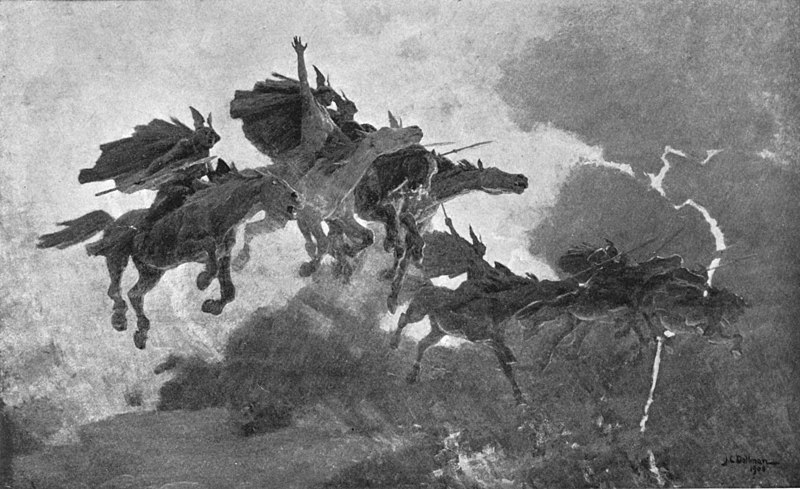
In the opera-house, the Ride .. begins in the prelude to the Act, building up successive layers of accompaniment until the curtain rises to reveal a mountain peak where four of the eight Valkyrie sisters of Brünnhilde have gathered in preparation for the transportation of fallen heroes to Valhalla. As they are joined by the other four, the familiar tune is carried by the orchestra, while, above it, the Valkyries greet each other and sing their battle-cry.
Valkyries, ride over the battlefield I'm dying and glad to bleed Because I know today I will take my place with the heroes in Valhalla of old
For none but the brave, be he king or a slave With a pounding heart in his chest Will be worthy to rise and with the Valkyries fly And ride to Valhalla of old
There are obvious connections here with Sovay's desire, death-worthy need for the truth, and the Valkyries mission in/for Valhalla.
---
Additional references in the song:
Don Quixote: From the Globe: Miguel de Cervantes Saavedra's book contains, in germ or full-blown or by implication, practically every imaginative technique and device used by subsequent fiction writers to engage their readers and construct their works. It crystallized forever the making of literature out of life and other literature, and explored in typically ironic fashion, and for the first time, the murky, illusory frontiers between fact and fiction, imagination and history, perception and physical reality.... By the time we reach the end of the book, it is eminently clear that these protagonists are not precisely the men they were when they started out on their quest for chivalric adventures... For example, what is called the "false Quixote,"... The fictional characters themselves deny the validity and veracity of the imitation... what we call "realism" and what Cervantes called "verisimilitude," or the appearance of truth. It also allows for a constant and discomfiting blurring of the lines between actuality and fiction.
Para (from the lyric "para-success") means "pair/couple" in Polish. Para also means "steam/vapor" in Polish (funny people, eh? ;). Para also alludes to parachutes, and is the B-17 was not only used for bombing, but also drop (parachute) missions by UK during WWII (the UK Parachute Regiments were called "1 PARA, 2 PARA, 3 PARA, etc.. ). Para in Sanskrit is an adjective meaning "transcendental" (Don Quixote???). Finally, para in english means close, beside, or next to.
---
At this time, I'd like to over-analyze that last phrase in the context of everything written so far, "Accidental suicide The kind where no one dies". Hmm.. an accidental suicide>/. Could it be a reference to soldiers in a war? As in, signing up for war, you understand the risks, but it really is psychologically suicide? Or maybe the idea of knowing something to be true, and then it turning out not to be true? .. the kind where no one dies... is it Love he's referring to? I don't know.. more needs to be done here... it's a nice phrase for sure.
---
Ok, that's enough for now. So with all this background, here's what I'm getting (ie. the take home message). There's large allusions to travel, to riding: (Sovay on her horse, Don Quixote and his horse, the B-17 flying fortress "The War Horse", Ride of the Valkyries, been here before, etc.. ). There is also a strong allusion to change and truth; to what is real and moreover, to when it is real (Don Quixote, Sovay's story, directly from the lyrics: "I was getting ready to consider my next plan of attack", "Accidental suicide The kind where no one dies".
---
Anyway, this could be the greatest song ever written, or I'm over-analyzing the shit out of it. I haven't even started analyzing the musical genius here. "That you're riding on the para-success Of a heavy-handed metaphor And a feeling like you've been here before"...
Accompanied by beautiful intricate drawings, seven innovative pop-ups reveal the inner workings of the experiment. There are many flaps to open and tabs to pull - the reader can even build their own pop-up ATLAS!
How does such a complex endeavour come to be? What are the challenges building and operating such a mind-boggling experiment? Three imaginative pop-ups show ATLAS in its underground cavern, the control centre on the surface and the tricky manoeuvring needed during installation.
The trailer above is for Between The Folds, a new feature documentary film presented by PBS's Independent Lens. You can view the whole film on PBS on December 8 (via Boingboing).
On a related note, here's a great talk by Robert Lang, from TED. Robert Lang is a pioneer of the newest kind of origami -- using math and engineering principles to fold mind-blowingly intricate designs that are beautiful and, sometimes, very useful.
By now you've probably heard that a bird caused a concern with LHC (no delay - the thing wasn't even on... just exposed a potential future problem). I'm not really posting about that.. just one of the great comments that followed a thread (via GeekPress)
--
The bird's briefing:
The approach will not be easy. You are required to maneuver straight down this trench and skim the surface to this point. The target area is only two meters wide. It's a small thermal exhaust port, right below the main port. The shaft leads directly to the reactor system. A precise hit will start a chain reaction which should destroy the station.
--
Anyway, kinda reminded me of a movie I watched over the weekend, Primer. Primer is a 2004 American science fiction film about the accidental discovery of time travel. The film was written, directed and produced by Shane Carruth, a mathematician and a former engineer, and was completed on a budget of $7,000. (via Wiki; don't read if you don't want the movie spoiled). Recommended by a friend, I ended up watching it 1.5 times to try to figure out the plot (with a little nap in between!). It's a pretty cool look at the old time travel paradoxes... and also a more realistic look (at least in my view.. ) at the more often than not serendipitous scientific discovery process. The process of new ideas and brain-storming seems to work the same way; by climbing that ladder through good teamwork and communication; bouncing ideas off each other "up the ladder". Anyway, off on a tangent there, but that's how I always pictured it.
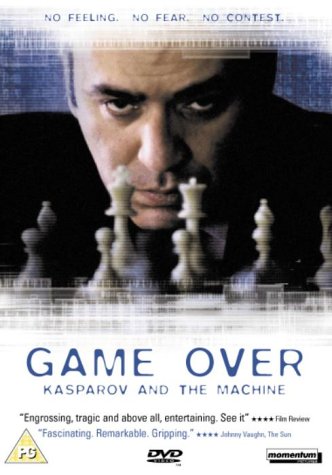
My interest in critical thinking games has spiked recently (probably cuz the law apps are in finally), specifically tower defense games, wordgames, and most recently chess and go. I watched the movie "Game Over: Kasparaov and the Machine" on a friend's recommendation, which kinda got me excited about chess and go, and I figure/feel both are something I wanna get at least pretty good at (along with the word games, eventually... ). I think, or at least I bet, that these skills are relatively transferable to every day scenarios, specifically with the planning ahead / big picture predictability of certain scenarios, which I'm admittedly pretty poor at.
After playing Go for about 3 hours the other night, I found out that there are a lot of things going on at once, and that I currently suck at it. Apparently there is a steep learning curve, and just like chess in the old USSR, the Chinese would send their kids away to school at a very young age, where whey would study the game for over 10 hours a day!
I started with a java tutorial that was pretty good for the basics. After that, if you're not frustrated to shit, there is a great tutorial program called The Many Faces of Go, which you can download for free here. There's also an iphone app called SmartGo. I have the .ipa for your jailbroken phone if you want it.
The history of the game is quite cool, and I'm sure Wikipedia does a better job of it than I would here.
Anyway, on a psychological / cognitive science level, there is some evidence that chess and go activate different parts of the brain, with go being more right hemisphere heavy. Moreover, perhaps predictably, these types of leisure games do seem to fight off (correlationally for now at least - there are definitely social aspect ties here) dementia and even Alzheimer's, and I won't say that that isn't a small part in my motivations for studying these things, despite the years I have left to go crazy. However, with 30-50% of the western population diagnosed with some sort of mental illness by the age of 32, Alzheimer's may be too forward thinking!








 Posts
Posts


