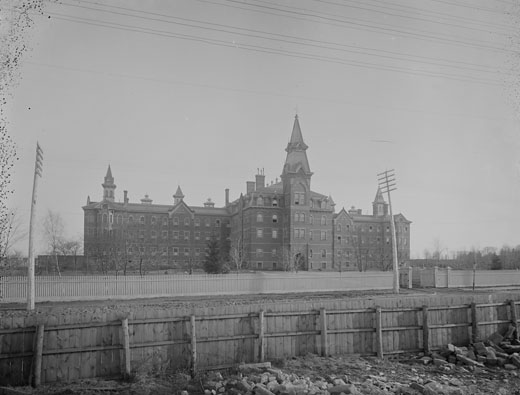
The Andrew Mercer Reformatory for Women was the first women's (16 years of age or older) prison in Canada, opened in 1872.
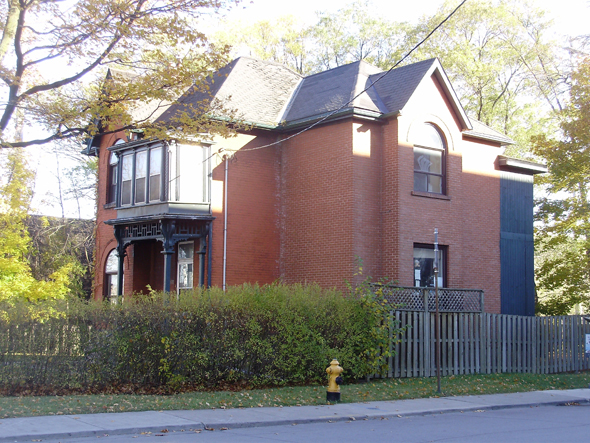
The original Mercer Reformatory superintendent's house survives at Fraser and King. The site of the old reformatory is Lamport Stadium, and all that remains is the original superintendent's house at the corner of King Street and Fraser Avenue.
So, you know how Joel Plaskett's back-to-back of "Rewind" and "Precious" work really well?... add these two to the formula.
here is a bit of a sample of the original genius.
(there was no original on the youtube that fit, but this guy kinda rocks out!)
--
This is the song for Baby Birch.
I will never know you.
And at the back of what we've done,
there is that knowledge of you.
I wish we could take every path.
I could spend a hundred years
adoring you.
Yes, I wish we could take every path,
because I hated to close
the door on you.
Do you remember staring,
up at the stars,
so far away in their bulletproof cars?
We heard the rushing, slow intake
of the dark, dark water,
and the engine breaks,
and I said,
How about them engine breaks?
And, if I should die before I wake,
will you keep an eye on Baby Birch?
Because I'd hate to see her
make the same mistakes.
When it was dark,
I called and you came.
When it was dark, I saw shapes.
When I see stars, I feel, in your hand,
and I see stars,
and I reel, again.
Well mercy me. I'll be goddamned.
It's been a long, long time
since I last saw you.
And I have never known the plan.
It's been a long, long time.
How are you?
Your eyes are green. Your hair is gold.
Your hair is black. Your eyes are blue.
I closed the ranks, and I doubled back--
but, you know, I hated to close
the door on you.
We take a walk along the dirty lake.
Hear the goose,
cussing at me over her eggs.
You poor little cousin.
I don't want your dregs
(A little baby fussing all over my legs).
There is a blacksmith,
and there is a shepherd,
and there is a butcher-boy,
and there is a barber, who's cutting
and cutting away at my only joy.
I saw a rabbit,
as slick as a knife,
and as pale as a candlestick,
and I had thought it'd be harder to do,
but I caught her, and skinned her quick:
held her there,
kicking and mewling,
upended, unspooling, unsung and blue;
told her "wherever you go,
little runaway bunny,
I will find you."
And then she ran,
as they're liable to do.
--
Man, I was going to post the rest of the lyrics and provide an interpretation with them (for the rest of the songs), but won't now just cuz I think potential misinterpretation is not what I'm looking for here. I'd rather do that in person ;) Basically I think these are just great.fucking.songs that should be listened to!
As for the Joel Plaskett lyrics, I'm damn sure they'll be posted here at some point again and again and again after that. Let's just say that in the absence of cut and paste, dude is pretty straight lovingly forward.
Anyway, if you would like to donate to RTP (here's some info about what they do: http://www.righttoplay.com/canada/about-us/Pages/AtAGlance.aspx
- their website is kinda meh...) then here is a good opportunity cuz I could get a free t-shirt out of it too.
You apparently can't donate on the internet so just send me an email with some sort of commitment and I'll collect next time I see you. If you know how to do that email bank transfer thing and I don't have to do too much, then that should be fine as well. If you want a tax receipt, include your mailing address. If you don't want a tax receipt, know that I may use it (el taxmano y yo quizás no estamos de acuerdo ;).
Joseph "Joey" Moss (born September 25, 1963) is the locker room attendant for the Edmonton Oilers of the National Hockey League and the Edmonton Eskimos of the Canadian Football League. Born with Down syndrome, Moss caught the eye of Oilers centre Wayne Gretzky in 1985, when Gretzky was dating Moss's sister, Vicki. Impressed with the dedication Moss brought to a job at an Edmonton bottle depot, Gretzky suggested to team general manager Glen Sather that the young man be given a tryout.
As the summer of 1986 came around, Gretzky was worried that Joey would lose everything he had learned with the Oilers, so Gretzky called up the equipment manager of the Edmonton Eskimos, Dwayne Mandrusiak, and asked him if Joey could work with them during training camp. Gretzky even offered to pay Joey's wages for the team.
Moss's career with the Oilers was destined to long outlast Gretzky's, and his determination and passion for hockey have made him a nationwide celebrity and a major symbol of continuity within the franchise. (In 2006, during a surprising Oiler playoff run, he delayed elective surgery for a hernia in order to see the Stanley Cup playoffs through to the finish.) His main duties with the team include cleaning, handling towels and water, and running errands for former equipment manager Lyle "Sparky" Kulchisky.
In 2003, Moss received the NHL Alumni Association's "Seventh Man Award" in recognition of outstanding behind-the-scenes service to the league. The Joey Moss Cup, a trophy contended for by Oilers players in an annual split-squad game near the end of training camp, is named after him.
Shawn Horcoff had a goal and an assist while Taylor Hall and Curtis Foster each had a goal for team Blue as they shutout Team white to win the Joey Moss cup 3-0 (yesterday).
Listening to them on CBC (man, Jian is such a douche - like repeating everything the band members say... we understand them Jian, just like you do. They're speaking English.. anyway) now. For a listen, above is their album for download via torrent.
Formed in 1998, the group consists of vocalist and guitarist Louis-Jean Cormier, keyboardist François Lafontaine, bass guitarist Martin Lamontagne, percussionist Julien Sagot and drummer Stéphane Bergeron. The band's name is a phonetic rendering of carquois (French for a quiver of arrows).
This is their fourth album, mostly acoustic. Good, but I would have gone with the Sadies.
Why an international court decision on Kosovo's declaration of independence could nullify the Clarity Act and permit a unilateral declaration of independence by Quebec. And: Federal Liberal Leader Michael Ignatieff recently asked Canadians to come back to the "Big Red Tent", but are big tent politics still possible, or is Canada looking for new ways to build majorities?
--
What the Kosovo ruling means for Canada: trouble
The true impact of the World Court’s decision will be on separatist groups outside of Serbia that now have a model for how to declare independence Lyle Stafford for The Globe and Mail
The true impact of the World Court’s decision will be on separatist groups outside of Serbia that now have a model for how to declare independence.
Start on E
AE
I’m getting old but I’m not old yet
BE
I’m already worried that I might forget
A
How to laugh, how to love
E
How to live, how to learn
BAE
I want to die with a smile when it comes my turn
I don’t want to get weary, don’t want to get bored
Don’t want to get tired, walking down this road
I’ve seen that happen so many times
I just want to believe that its still worth trying
Chorus
But I know that it’s easier said than done
And I ain’t that different from anyone
I worry about my money, got bills that I can’t pay
I swear I’m more like my father everyday
Chorus
Maybe I’ll start bowling, maybe I’ll play bridge
Maybe I’ll join a band with my own grandkids
I don’t care if it kills me I’m gonna do what it takes
To keep some warmth in my heart and a smile on my face
Chorus
End on E.
--
David Myles (born May 12, 1981) is a Canadian songwriter / performer/ recording artist originally from Fredericton, New Brunswick, Canada. He now resides in Halifax, Nova Scotia.
Growing up in Fredericton, David started playing trumpet at 10 years old, playing in his school band. He later attended Mount Allison University in Sackville, New Brunswick where he was studied to completed his degree in political science, with a minor in Chinese. In 2001, David embarked on an exchange to a city two hours from Shanghai, China, to learn Mandarin and purchased his first guitar. He later graduated from Mount Allison University in 2003 with an honours degree in Political Science and is now a full time touring musician. After returning from China, David released his debut solo recording, Together and Alone in 2005 and relocated to Calgary.
In 2006, his second solo recording, Things Have Changed, exposed him to national and international audiences and earned him industry recognition in the form of two Music Nova Scotia Awards, and nominations for both the 2007 Canadian Folk Music Best New Artist Award and the ECMA Galaxie Rising Star Recording of the Year. His original song, “When it Comes My Turn” took home first place in the International Songwriting Competition and was the winning song at the 2008 Chris Austin Merlefest Songwriting Contest.
My friend Tara, who's leaving to study/write at St. Andrew's on a Scotland Saltire Scholarship in a week or two posted the little ditty below not too long ago. To provide a little bit of background to this passage the hints, allegations and things left unsaid all point to Tara staying in Scotland/Europe for a very long time.
--
"It is music for exile, for the preparations, the significations of departure, for the symptoms of migration. It is the languishing music of picking through your belongings and deciding what to take. It is the two a.m. music of smelling and caressing books none of which you can carry--books you leave behind with friends who say they’ll always be here when you want them when you need them--music for a bowl of apples sitting on your table, apples you have not yet eaten, apples you cannot take--you know they have apples there in that other place but not these apples, not apples like these-- You eat your last native apple and stare at what your life is reduced to--all the things you can stick into a sack. It will be cold, you will need boots, you don’t own boots except these rubber ones--will they do? You pack them, you pack a letter from a friend so you will not feel too alone.
Music for final goodbyes for one last drink and a quick hug as you cram your cigarettes into your pocket and run to the bus, you run, run, your chest heaves, like the bellows of the bandoneon. You try to watch intently to emblazon in your mind these streets, these corners, those houses, the people, the smells, even the lurching bus fills you with a kind of stupid happiness and regret-- Music for the things you left behind in that room: a dress, magazines, some drawings, two pairs of shoes and blouses too old to be worn any more . . . four perfect apples.
Music for cold nights under incomprehensible stars, for cups of coffee and cigarette smoke, for a long walk by the river where you might be alone or you might meet someone. It is music for encounters in shabby stairways, the music of lovemaking in a narrow bed, the tendernesses, the caress, the pull of strong arms and legs.
Music for your invisibility . . .
Music for a day in the fall when you buy a new coat and think perhaps you will live here for the rest of your life, perhaps it will be possible, you have changed so much, would they recognize you? would you recognize your country? would you recognize yourself?"
In 1993 his one-man show, Fronteras Americanas, premiered at the Tarragon Theatre ’s Extra Space. It was subsequently produced at Festival de Theatre des Amériques (now Festival TransAmériques ) in Montreal, then remounted on Tarragon’s main stage, before moving to the Manitoba Theatre Centre and Vancouver Playhouse . In all of the productions Verdecchia played himself and his alter-ego, Wideload, a flamboyant Latino stereotype. The play is an attempt to resist the objectification effected by naming in terms of race and place through the formation of an “oppositional consciousness.” The Verdecchia persona reflects on his experiences as an immigrant to Canada. He provides a history lesson on the diaspora of “Latin” peoples in order to construct for himself an historical context. Ironically when he returns “home” to Argentina, and he again finds himself an outsider. Wideload comments sarcastically on his reception by a “Saxon” population and contrasts the physical and sexual makeup of a “Latino” with that of a “Saxon.” In the concluding episode, the character Verdecchia asserts that he is building a house on the border, and challenges the audience to consider and celebrate the rich ethnic makeup of those who call Canada home. Fronteras Americanas won a Chalmers Award and a Governor General’s Award . Verdecchia also wrote and starred in a short film adaptation of Fronteras Americanas, called Crucero/Crossroads, which played at film festivals around the world and received nine international awards.
--
Anyway, the passage reminded me of the following song, music for pleasure by Departure Lounge. I couldn't find the song or lyrics anywhere online so I uploaded them to YouTube and here. I'm not 100% sure about the lyrics as I embrace a biased ear, but they should be close enough.
Departure Lounge - Music for pleasure
Stamp my ticket, pull my plug I'm tuning out and I'm turning off I'm not the hero that I thought I was
I don't want to be up there looking down everything is small from far away I want to see you up close again
Tap my wire, feed my line pull me out of my frozen mind gotta get back into the world outside music for pleasure
Cover your ears, count to three, you'll need a torch if you're following me. I need some air and a new routine plus some device to help me stay in touch with how I feel.
Tap my wire, feed my line pull me out of my frozen mind gonna get these puppet strings untied I'm not another broken fairground ride if your heart is empty, open wide.
Tap my wire, feed my line pull me out of my frozen mind I'm going to leave that joker I was behind music for pleasure.
No more pressure, no more pain, no more struggle for hollow gain I want to feel like I'm alive again Older and wiser be nice to each other music for pleasure
--
Reading and comparing the two passages, at first glance they don't seem to click quite right. I mean, on the surface you have the music, the travel, the transportation of oneself and the sense of the journey, lack of a home. But something just doesn't click, right? There is a complexity to Verdecchia's passage that DL just can't come close to. They are quite obviously not in the same league. The personal examples, the consumption and assimilation of loss, memories and movement.
And then, at least for me, the two passages do click. I feel they are expressing similar feelings in slightly different ways, perhaps emotions connected to a far away place, thing, or even person. Something that you wish you could keep forever but know you probably shouldn't (for the better of you) and really can't in any real sense anyway. If it does come back it won't be the same, which is a good thing; it'll be different and better. A new, fresh start after a disappearance, whether you like it or not. At least, that's the way I interpreted it!
This song is easily in my top 15. Not only is it melodic, but I do love the simple and vague electrically and mechanically related lyrics.
--
"I need some air and a new routine plus some device to help me stay in touch with how I feel.
Tap my wire, feed my line pull me out of my frozen mind gonna get these puppet strings untied I'm not another broken fairground ride if your heart is empty, open wide."
--
Basically I've found I love any lyrics to do with wire transmissions (as receivers and as senders: as the transmission goes down the wire you need repeaters or the intended message slowly fades away type analogies... ) and broken, under maintained, neglected mechanical equipment, but that's another story all together.
Listening to this song my mind instantly flashes back 7-8-9 years ago, driving my 1997 silver Acura down a black highway, simultaneously travelling away from and toward loved things and ones.
So had my first two official law school classes yesterday and my overall impression is that it is going to be fucking amazing. There are obviously going to be some challenges, and maybe not the ones one may instantly think of. What I mean is that personally I'm not worried about the work load, exams, or the written aspect of detailing information to match up the law, cases and the facts. What I'm more worried about, and need to get better at is to be able to (to learn to) get out of my head and coherently express myself and these ideas verbally in a quick, strategic, and systematic manner. To be a bit more precise, I tend to be able to form a logical, well thought out and expressed argument on paper, but when it comes to verbal communication I tend to get stuck in my head a bit.
That's the long term goal (always has been for a bit now.. ) and that's something that Queen's seems to emphasize with the small classes and their omnipresent Socratic teaching. The profs seem to be emphasizing the absolute requirement to make mistakes in class discussions, with marks coming only based on written exams. I'm kinda digging that right now and am looking forward to the personal challenge of trying and fucking up.
Anyway, first class of the day was Property Law. Our homework for this first class was to watch this YouTube clip:
Superb!
1) "Tell us why?!" Should they have to tell him why? 2) "Who gave you the right to exclude the population?!" Pretty loaded question... 3) "We want to get into the Eaton Centre, it is a public place!" Rights associated with services...
anyway, neat stuff. And not to bore you too bad with anymore but there seems to be 6 general types of property law, with the major distinctions being real estate, personal property, intangibles (stocks and bonds), intellectual, infrastructure and you as a person property. That last one garnered the most attention with examples of tattoos on foreheads, kidney selling vs. donating, and slavery coming into play; basically it's all about drawing a line somewhere.. what should the legal system endorse and what should it condemn. That ambiguity is where good lawyers shine, apparently.
blah, blah, blah..
Other interesting things touched upon in this first class was a definition of property. The take home message was that it came down to not necessarily something that you own or possess but is actually your claims, entitlements, duties and rights associated with the object/issue in question). Moreover, it was touched on that property is something you can potentially give away or sell, so your SIN may not actually be "your property".
Ok, second class was Torts and we started to get into the rules associated with statutory interpretation, the type of thing I think I want to get into. I'll avoid details as I don't think you care, but we played a fun game of interpreting the hypothetical sign "No vehicles in the park". As you can probably guess, different types of "vehicles" were brought up and debated whether they were covered by the sign/law/rule and why and how, and how would one defend each side... and yes, of course bicycle came up!.. along with child buggy, lawn mower, electric wheelchair, ambulance and limo drivers.. all interesting to dissect intent of law vs. learning and being aware of the leaps one is allowed to make in the process of defending your prosecutor or defendant role.
Anyway, near the end of the class the prof emphasized that mistakes should be made in class, learn the skills not the content (not rote memorization), have some fun with these discussions to keep up your interest, keep it simple as laws contain ambiguity and fundamental questions are the best way to work within that ambiguity, that profs are just tour guides and not the be all and end alls, and finally he mentioned that questions on course content could only be asked in class in front of the rest of the class. This is designed to get people talking and to get comfortable with making mistakes.
Pretty great first day, and no more about classes cuz re-reading this it's boring me.
Oh, one last thing.. met with my upper year buddy who eased my mind a bit about summary techniques, work load, exams, future job prospects, and profs, and also hooked me up with some used books. I'm not sure to what extent this happens at other law schools but Queen's is really looking like the right choice for me...
William Gladstone was very nearly Abraham Lincoln's exact contemporary, both born in 1809 (Lincoln was 10 months older), only he was born in Liverpool, not Kentucky. He was a legendary orator and liberal lion, like an approximation of Lincoln and Ted Kennedy. He served as a member of parliament for almost 50 years, including as Prime Minster four times, before retiring in 1894. (Could you imagine if Lincoln had lived until 1894?) In a career lasting over sixty years, he served as Prime Minister four times (1868–1874, 1880–1885, February–July 1886 and 1892–1894), more than any other person. Gladstone was 84 years old - still physically vigorous albeit with failing hearing and eyesight - when he resigned for the last time, making him Britain's oldest Prime Minister.
He also had a great nickname: G.O.M., for "Grand Old Man." His Tory counterpart Disraeli called him "God's Only Mistake."
no, not G.O.B., but G.O.M.
anyway, his relation to the Gladstone hotel in Toronto is as follows.
The Gladstone was named for Gladstone Avenue, which was named after British prime minister William Ewart Gladstone. The hotel's monthly newsletter, the Gladstone Bag, is named for the suitcase style, also named for William Gladstone.
The Gladstone was one of the first ten hotels in Ontario to receive permission to allow patrons to drink and play shuffleboard in a licensed alcoholic area. At one time the Gladstone Hotel was the last place to obtain hard liquor before reaching Hamilton.
Ok.. that's part one of this post. In part two I'm gonna take a look at the phonograph, Thomas Edison, and good vibrations.


 Posts
Posts

