
Roncesvalles Polish Festival, Queen West Art Crawl, and Parkdale is throwing it down too.


What the Dog Saw is a collection of his writing from The New Yorker. Here's an annotated table of contents with links to all the articles and the dates on which they originally appeared in the magazine:
The Pitchman - Ron Popeil and the conquest of the American kitchen. (Oct 30, 2000)
The Ketchup Conundrum - Mustard now comes in dozens of different varieties. Why has ketchup stayed the same? (Sept 6, 2004)
Blowing Up - How Nassim Taleb turned the inevitability of disaster into an investment strategy. (Apr 22, 2002)
True Colors - Hair dye and the hidden history of postwar America. (Mar 22, 1999)
John Rock's Error - What the inventor of the birth control pill didn't know about women's health. (Mar 13, 2000)
What the Dog Saw - Cesar Millan and the movements of mastery. (May 22, 2006)
Open Secrets - Enron, intelligence and the perils of too much information. (Jan 8, 2007)
Million Dollar Murray - Why problems like homelessness may be easier to solve than to manage. (Feb 13, 2006)
The Picture Problem - Mammography, air power, and the limits of looking. (Dec 13, 2004)
Something Borrowed - Should a charge of plagiarism ruin your life? (Nov 22, 2004)
Connecting the Dots - The paradoxes of intelligence reform. (Mar 10, 2003)
The Art of Failure - Why some people choke and others panic. (August 21, 2000)
Blowup - Who can be blamed for a disaster like the Challenger explosion? No one, and we'd better get used to it. (Jan 22, 1996)
Most Likely to Succeed - How do we hire when we can't tell who's right for the job. (Dec 15, 2008)
Dangerous Minds - Criminal profiling made easy. (Nov 12, 2007)
The Talent Myth - Are smart people over-rated? (Jul 22, 2002)
Late Bloomers - Why do we equate genius with precocity? (Oct 20, 2008)
The New Boy Network - What do job interviews really tell us? (May 29, 2000)
Troublemakers - What pit bulls can teach us about crime. (Feb 6, 2006)


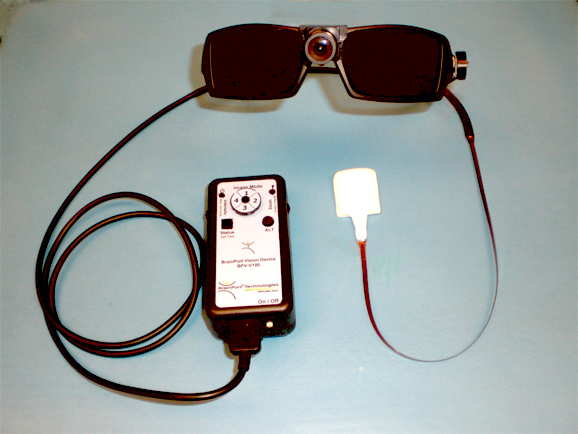
The late Paul Bach-y-Rita could be considered the father of all technology used to reprogram the human senses. In 1963, Bach-y-Rita developed a “Tactile to Visual Sensory Substitution” device. It converted images from a camera to tactile sensations that a blind person could feel on his or her back. Bach-y-Rita’s research was all based on the notion of “sensory substitution.” The brain, he argued, was not hardwired and that a working sense, say touch, could be used to replace a failing one, e.g. vision. His ideas around the plasticity of the human brain were very controversial at the time but widely accepted today. He continued his research on sensory substitution technology at the University of Wisconsin-Madison, and his company Wicab, until his death in 2007.
“I can connect anything to anything,” Bach-y-Rita said in a profile in The Telegraph shortly before his death:
We see with our brains, not with our eyes. When a blind man uses a cane he sweeps it back and forth, and has only one point, the tip, feeding him information through the skin receptors in the hand. Yet this sweeping allows him to sort out where the doorjamb is, or the chair, or distinguish a foot when he hits it, because it will give a little. Then he uses this information to guide himself to the chair to sit down. Though his hand sensors are where he gets the information and where the cane “interfaces” with him, what he perceives is not the cane’s pressure on his hand but the layout of the room: chairs, walls, feet, the three-dimensional space. The receptor surface in the hand becomes merely a relay for information, a data port.
In the latest incarnation of Bach-y-Rita’s work, the data port is the tongue...."

 Posts
All Comments
Posts
All Comments


