It was Patrick Maloney of the Lemelson Foundation who suggested to me that vetting high-risk, early-stage efforts is really about pattern recognition. He explained that you get really good at recognizing one “pattern” that works—one type of team or approach that is likely to succeed. But recognizing one pattern doesn’t mean that you’re good at catching all of the good ideas. You end up missing a lot of things that might succeed, because you’re really good at seeing the single type of pattern you know. As Maloney explained to me, “You may get good at picking grants that work, but you’ll never be great at picking what won’t work, because you don’t know what other types of things, outside your pattern, will succeed.”
And this is where the power of networks comes into the picture.
This really reminds me of conversations I used to have in university with Eric Chang... so, in light of that, here is an abbreviated trip to Japan montage!
While the cats away...
This was taken not even a year ago. Krispy Kreme. The clock tower in the background shows it's after 10:30, pm obviously... Enormous line-up outside... unbelievable.
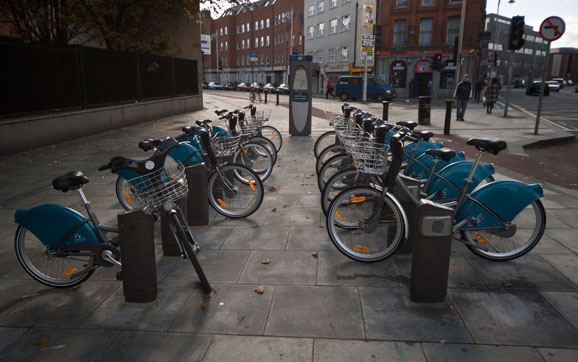
In case you missed it last week: Dublin now has a new bike share system called dublinbikes. Dubliners can get a “subscription” to the service for a year for 10 euros. With a subscription, you can take out a bike for up to 30 minutes for free (and for longer periods by paying a graduated fee). Visitors can get a 3-day pass for two euros.
Yeah, I don't usually post stuff like this, and I know this kind of thing happens every day, every second, and, I suppose, much much worse... but, I'm posting it as another reminder for me...
What a great idea... application could use some work. The iphone really has nothing to do with this, but it's a nice idea... just, don't think you wanna go around biking monocularly.
In a consideration of Robic, three facts are clear: he is nearly indefatigable, he is occasionally nuts, and the first two facts are somehow connected. The question is, How? Does he lose sanity because he pushes himself too far, or does he push himself too far because he loses sanity? Robic is the latest and perhaps most intriguing embodiment of the old questions: What happens when the human body is pushed to the limits of its endurance? Where does the breaking point lie? And what happens when you cross the line?
The craziness is methodical, however, and Robic and his crew know its pattern by heart. Around Day 2 of a typical weeklong race, his speech goes staccato. By Day 3, he is belligerent and sometimes paranoid. His short-term memory vanishes, and he weeps uncontrollably. The last days are marked by hallucinations: bears, wolves and aliens prowl the roadside; asphalt cracks rearrange themselves into coded messages. Occasionally, Robic leaps from his bike to square off with shadowy figures that turn out to be mailboxes. In a 2004 race, he turned to see himself pursued by a howling band of black-bearded men on horseback.
‘‘Mujahedeen, shooting at me,’’ he explains. ‘‘So I ride faster.’’
---
In all decisions, Stanovnik governs according to a rule of thumb that he has developed over the years: at the dark moment when Robic feels utterly exhausted, when he is so empty and sleep-deprived that he feels as if he might literally die on the bike, he actually has 50 percent more energy to give.
---
In 1999, three physiologists from the University of Cape Town Medical School in South Africa took the next step. They worked a group of cyclists to exhaustion during a 62-mile laboratory ride and measured, via electrodes, the percentage of leg muscles they were using at the fatigue limit. If standard theories were true, they reasoned, the body should recruit more muscle fibers as it approached exhaustion — a natural compensation for tired, weakening muscles.
Instead, the researchers observed the opposite result. As the riders approached complete fatigue, the percentage of active muscle fibers decreased, until they were using only about 30 percent. Even as the athletes felt they were giving their all, the reality was that more of their muscles were at rest. Was the brain purposely holding back the body?
‘‘It was as if the brain was playing a trick on the body, to save it,’’ says Timothy Noakes, head of the Cape Town group. ‘‘Which makes a lot of sense, if you think about it. In fatigue, it only feels like we’re going to die. The actual physiological risks that fatigue represents are essentially trivial.’’
---
‘‘I find motivation everywhere,’’ Robic says. ‘‘If right now you look at me and wonder if I cannot go up the mountain, even if you are joking, I will do it. Then I will do it again, and maybe again.’’ He gestures to Mount Stol, a snowy Goliath crouched 7,300 feet above him, as remote as the moon. ‘‘Three years ago, I got angry at the mountain. I climbed it 38 times in two months.’’
(this kids cracks me up.. I'm in the office, and can't stop smirking... needing to pretend that it's something funny someone else said!)
Women aged 30 to 34 gave birth to 115,415 of the 367,864 babies born in 2007, more than any other age group and the second consecutive year they led all age groups. And all women 30 and over accounted for 56 per cent of all births.
The trend of more women having children later in life helped Canada hit a number of fertility milestones.
The total number of births was the highest since 1995 and the fifth consecutive annual increase.
The fertility rate, or the average number of children per woman, increased from 1.59 in 2006 to 1.66 in 2007, the highest since 1992.
Total births from 2006 to 2007 increased by 13,247, or 3.7 per cent, the fastest annual increase since 1989.
The increase in births from 2006 is all the more surprising because 2006 was itself a banner year for births.
Baby boom happening around the world
The baby boom is not unique to Canada, Statistics Canada said in its report. Other countries with low fertility rates, such as the United States, Australia, Spain and Sweden, have also experienced an increase in their fertility rates.
Personally, I think this is pretty freaking awesome. I mean, people are making adult choices these days and are able to advancing their lives/education/careers as they choose! There seems to be a mini-baby boom as children of baby boomers have the fantastic opportunity to wait... and hence the delay in child birthing in developed countries for all women(?)... and now it seems to be time if you did want a family(?). I don't know, maybe my perspective is not full enough. I guess, a decrease in religious importance may play a factor?... I think I'm gonna stop here with the printed over-analysis on this subject!
So there have been a few of these proposed, and some have been built on earth... to my knowledge, none have been done in space yet. Ok, first things first; what are gravitational waves and why are they important?
Gravitational waves are ripples in the fabric of space and time produced by violent events in the distant universe, for example by the collision of two black holes or by the cores of supernova explosions.
Quoting from the article: "The team says the observations should help them understand how galaxies and supermassive black holes evolve together, shed light on the physics of the early universe such as inflation as well as probing the nature of space-time, perhaps revealing quantum gravity corrections to classical gravity. It may even throw up some new sources of gravitational waves."
The "this applies to everything" theory... and yeah, it kinda does. It would be great to see how one coudl unify classical gravity to quantum gravity. Moreover, Einstein predicted them in his theory of general relativity, they are potentially a source of energy (just as ocean waves are on earth), they mesh/work with multi-dimensional theories, and seem to be essential to the unification theory.
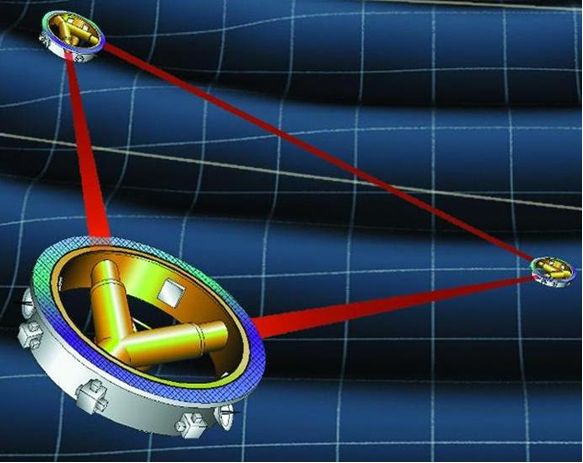
How to detect these waves: basically, shoot a light across a long distance and see if it ripples, or strains under 'gravity'..
How one of these wave detectors looks on earth - The LIGO detector can see ripples in space from neutron stars...
And future projects: have detectors calibrated in space over much larger distances for greater sensitivity.
The NANOGrav team estimates the cost of its project over ten years to be a mere $66 million.
It expects to be up and running by 2020 and at that price looks remarkably good value. Of course, this will not happen on time or budget.
Who doesn't want to make cheese? Something I would need someone's help with, that's for damn sure. Looks pretty complicated, and temperature/time sensitive.. Apparently mozzarella is the training grounds for this stuff..
secret heart
what are you made of
what are you, so afraid of
could it be, three simple words
or the fear of being overheard
whats wrong?
let her in on your secret heart
secret heart
why so mysterious
why so secret, why so serious
maybe your, just acting tough
maybe your just, not man enough
whats wrong?
let her in on your secret heart.
the very secret, your trying to conceal,
is the very same one, your dying, to reveal,
go tell her how you feel
secret heart,
come out and share it
this loneliness, few can bear it
could it have, something to do with
admitting that you, just cant go through it alone,
let her in on your secret heart.
Made even better (?!) by Leslie Feist. Absolutely gorgeous live version.









 Posts
Posts

