Tuesday, December 1, 2009

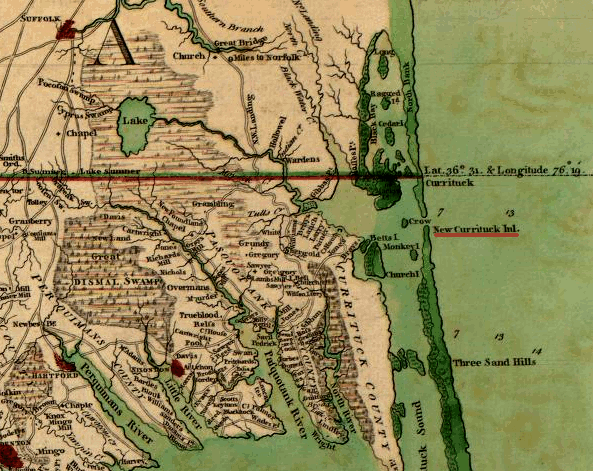
How did the states establish long straight borders before GPS?

How did the states establish long straight borders before GPS?

Step 2. Understand the difference between true north and magnetic north. Magnetic compasses don't point to the north pole, but rather to a spot about 500 miles distant, a fact surveyors take into account when determining true north. Everybody gets this. What they may not get is that compensating requires constant adjustment as you move around.

This subtlety was lost on some early surveyors. The knuckleheads who laid out most of the Virginia-North Carolina-Kentucky-Tennessee border didn't realize they needed to adjust their adjustments, so as they headed west, the boundary curved north. The surveyors who handled the western end of the border, working east from the Mississippi, covered less ground and so had less chance to screw things up. Where the two lines meet, at the Tennessee River, there's a 12-mile jog still conspicuous on maps.

(via Geekpress)

...

At various points since the early 19th century, Georgia has disputed its northern border with Tennessee, thereby denying Georgia its historical riparian and navigation rights to the waters of the Tennessee River. In 1796, when Tennessee was admitted to the Union, the border was originally defined by United States Congress as located on the 35th parallel, thereby ensuring that at least a portion of the river would be located within Georgia. As a result of an erroneously conducted survey in 1818 (ratified by the Tennessee legislature but not Georgia), however, the actual border line was set on the ground approximately one mile south, thus placing the disputed portion of the river entirely in Tennessee.[5][6]

Georgia made several unsuccessful attempts to correct what Georgia felt was an erroneous survey line 'in the 1890s, 1905, 1915, 1922, 1941, 1947 and 1971 to "resolve" the dispute', according to C. Crews Townsend, Joseph McCoin, Robert F. Parsley, Alison Martin and Zachary H. Greene, writing for the Tennessee Bar Journal, a publication of the Tennessee Bar Association, appearing on May 12, 2008.

(via Wikipedia)


http://www.virginiaplaces.org/boundaries/ncboundary.html

One of the greatest books you'll ever read


http://www.amazon.com/Surely-Feynman-Adventures-Curious-Character/dp/0393316041
Here's the pdf
Here's the audio book for your next road trip.

You don't need to like science to love this book.

Feynman's Father

Richard Feynman is one of my favorite people of the 20th century. And he had a wonderful father. Below are some excerpts, from What Do You Care What Other People Think?, showing what Feynman's childhood was like:

When I was just a little kid, very small in a highchair, my father brought home a lot of little bathroom tiles--seconds--of different colors. We played with them, my father setting them up vertically on my highchair like dominoes, and I would push one end so they would all go down.

Then after a while, I'd help set them up. Pretty soon, we're setting them up in a more complicated way: two white tiles and a blue tile, two white tiles and a blue tile, and so on. When my mother saw that she said, "Leave the poor child alone. If he wants to put a blue tile, let him put a blue tile."

But my father said, "No, I want to show him what patterns are like and how interesting they are. It's a kind of elementary mathematics." So he started very early to tell me about the world and how interesting it is.

Feynman's family had the Encyclopedia Britannica (remember those?) and his dad would sit Richard on his lap, and read to him.

We would be reading, say, about dinosaurs. It would be talking about the Tyrannosaurus rex and it would say something like, "This dinosaur is twenty-five feet high and its head is six feet across."

My dad would stop reading and say, "Now, let's see what that means. That would mean that if he stood in our front yard, he would be tall enough to put his head through our window up here." (We were on the second floor.) "But his head would be too wide to fit in the window." Everything he read me he would translate as best he could into some reality.

It was very exciting and very, very interesting to think there were animals of such magnitude--and that they all died out, and that nobody knew why. I wasn't frightened that there would be one coming in my window as a consequence of this. But I learned from my father to translate: everything I read I try to figure out what it really means, what it's really saying.

Of course, Feynman's father taught him more than how to translate from words to reality. He also taught him to go from reality to words.

My father taught me to notice things. One day I was playing with an "express wagon," a little wagon with a railing around it. It had a ball in it, and when I pulled the wagon I noticed something about the way the ball moved. I went to my father and said, "Say, Pop, I noticed something. When I pull the wagon, the ball rolls to the back of the wagon. And when I'm pulling it along and I suddenly stop, the ball rolls to the front of the wagon. Why is that?

"That, nobody knows," he said. "The general principle is that things which are moving tend to keep on moving, and things which are standing still tend to stand still, unless you push them hard. This tendency is called 'inertia,' but nobody knows why it's true." Now, that's a deep understanding. He didn't just give me the name.

He went on to say, "If you look from the side, you'll see that it's the back of the wagon that you're pulling against the ball, and the ball stands still. As a matter of fact, from the friction it starts to move forward a little bit in relation to the ground. It doesn't move back."

I ran back to the little wagon and set the ball up again and pulled the wagon. Looking sideways, I saw that indeed he was right. Relative to the sidewalk, it moved forward a bit.

That's the way I was educated by my father, with those kinds of examples and discussions. It has motivated me for the rest of my life, and make me interested in all the sciences. (It just happens I do physics better.)

I've been caught, so to speak--like someone who was given something wonderful when he was a child, and he's always looking for it again. I'm always looking, like a child, for the wonders I know I'm going to find--maybe not every time, but every once in a while.

5 comments:

bbrown said...

That book firmed up in my mind that I would never be the type of parent that would shut down a "why." My kids give up long before I ever do.

Daniel said...

Thanks for the comment. The way you put that is correct too--i.e., never being the type of parent that shuts down a "why."

The value of a "let's see" in answer to any question doesn't shut down the sense of wonder typical in a child.

And, ultimately, I think that matters more than having detailed answers or being able to point out interesting observations without fail--not that there's anything wrong with these!

If the goal is as you stated it, then it it achievable by all. And I--strike that--people don't have to be as knowledgeable as Feynman's father to raise an inquisitive child who is enthralled by all the wonders of reality.


...............

I remember staying up two nights straight listening to this audiobook and painting that map on our dining room wall. I still can't believe my parents let me do that.


So, why exactly is blackmail illegal?


From recent National Post and New Yorker articles..

Halderman discovered Letterman was having an affair with a staff member. Not illegal. Halderman decided to write a screenplay about it. Screenplays, particularly truthful ones, are also not illegal. Halderman then sought to sell his own work, as people are allowed to do. Now if Halderman had shopped his script to Fox or NBC, he would have broken no laws. Similarly if he had sold what he knew to TMZ or some other gossip website, he would have been free and clear. And if Letterman had caught wind of the screenplay and offered, on his own, to pay Halderman $2-million for the privilege of burning it, that too would have been completely legal.

It was only when Halderman implied he might sell the screenplay somewhere else if Letterman didn't pay up that he was alleged to have committed grand larceny, which carries a maximum sentence of 15 years. So selling the screenplay is legal. But threatening to sell it isn't. Why?

...

Richard Epstein, the University of Chicago and N.Y.U. law professor, said, “There’s this terrible fear of monopoly power. Halderman is sort of a local monopolist.” To show that he shouldn’t be allowed to “put the squeeze on the guy,” Epstein said, “you have to prove that a world where blackmail is illegal is a better place.” Epstein is the author of an essay called “Blackmail, Inc.,” in which he describes what it would be like if blackmail were legal and were handled by big corporations. In that scenario, Epstein said, Halderman would have hired Blackmail, Inc. “So Blackmail, Inc., goes to Letterman, and they say, ‘Look, this is going to really bust your chops if this gets out, but we’re going to help you keep it a secret. So the company puts out false public information designed to throw people off the scent.” The problem, he said, is that blackmail leads to fraud: “You lie to the world. And lying to the world is wrong.”

Other experts addressed the ick factor. “It has something to do with the truth about human psychology,” Mitchell Berman, a legal theorist at the University of Texas, said. “There’s an anti-commodification norm” (meaning that people aren’t O.K. with there being a market for some things; he mentioned prostitution). Lindgren imagined a cash-free, and legal, scenario: “If Halderman had said, ‘Stop doing this or I’ll expose you,’ and Letterman said, ‘I don’t want to stop doing this,’ and Halderman had said, ‘I’m forcing you to stop doing this or I’ll ruin your reputation’—that would probably not have been blackmail.” The Harvard law professor Steven Shavell, who calls himself a “quasi Letterman fan,” said the issue lay with Halderman’s motives: it’s about “hurting the person who committed the crime.” He suggested that Halderman’s attempt was wrong for the same reasons that vigilante justice is wrong, and he downplayed the idea of a “blackmail paradox,” calling such a notion “a toy of philosophically oriented academics.”

A final call went out to Walter Block, the libertarian economist. Block believes that blackmail, like smoking, is “yucky” but should be legal. “He only threatened to be a gossip—maybe a screenwriter,” he said of Halderman. “Screenwriting and gossiping are legal. If it’s legal to do it, it should be legal to threaten to do it.” Of Halderman’s defense team, he said, “If the purpose is to promote justice, they should argue that it’s an unjust law, and he should get off free.” Of his fellow ethics experts, he said, “They wouldn’t know just law if it bit them in the rear end.”


>...
The Cosby Extortion Case. As Eugene notes, someone with an
underlying legal claim may threaten to expose it to reach a reasonable
settlement. Yet if the amount sought is so substantially out of line

with the injury and the threat to embarrass is a big part of the

threat, then a criminal charge of extortion can be established.
....

So, basically, it seems to come down to two things. One, using the monopoly power to gain significant increased advantage in a 'negotiation'. I can see this for sure, but, threatening to expose your product to an open market shouldn't be considered illegal, I think. I mean, it's worth as much to you as you're willing to pay. If that's the seller's price to you - versus it being sold for less to others(??); does that make it illegal? Is this extortion? Two, the 'ick' factor, which I don't buy at all really.

...

Despite all these logical inconsistencies, the jurisprudence of blackmail is well established and Halderman's legal gambit probably doesn't have a leg to stand on. Perhaps a new screenplay is in order --one about the injustices faced by blackmailers. He should have plenty of time to work on it.
Thursday, November 26, 2009

Wednesday, November 25, 2009

Song of the day: The White Stripes - There's No Home For You Here

There's no home for you here girl, go away
There's no home for you here

I'd like to think that all of this constant interaction
Is just the kind of make you drive yourself away
Each simple gesture done by me is counteracted
And leaves me standing here with nothing else to say

Completely baffled by a backward indication
That an inspired word will come across your tongue
Hands moving upward to propel the situation
Have simply halted
And now the conversation's done

There's no home for you here girl, go away
There's no home for you here

I'm only waiting for the proper time to tell you
That it's impossible to get along with you
It's hard to look you in the face when we are talking
So it helps to have a mirror in the room

I've not been really looking forward to the performance
But there's my cue and there's a question on your face
Fortunately I have come across an answer
Which is go away
And do not leave a trace

There's no home for you here girl, go away
There's no home for you here

Waking up for breakfast
Burning matches
Talking quickly
Breaking bubbles
Throwing garbage
Drinking soda
Looking happy
Taking pictures
So completely stupid
Just go away

There's no home for you here girl, go away
There's no home for you here

...

When I first copies the lyrics for here, the "Breaking bubbles" lyric (as appears on the official website) was "breaking baubles". What the heck are baubles?

Christmas ornaments!

http://en.wikipedia.org/wiki/Bauble

I feel like I've been falling behind my music here a bit. Time to spin the black circle for a bit tonight, before Calgary.

Monday, November 23, 2009

Part of the Alex Anthopoulos/Paul Beeston plan...


(this is still the only photo I've ever seen of the dude)

http://msn.foxsports.com/mlb/story/10416132/Blue-Jays-bring-in-more-scouts-to-help-fill-roster

Six years after the release of "Moneyball," the stats vs. scouts debate is coming almost full circle.
"Moneyball," written by Michael Lewis, detailed the A's use of statistical analysis to exploit inefficiencies in the player market, demeaning the role of scouts in the process.

Alex Anthopoulos, the Blue Jays' new general manager, is increasing the team's number of domestic scouts from 28 to 54 in an attempt to better compete with the Yankees and Red Sox in the AL East.

Anthopolous, 32, is no old-school throwback, longing for the days when teams relied solely on scouts' opinions and not computers. Quite the contrary. He grew up reading Bill James, believes in blending subjective and objective analysis, and uses Tom Tango, a leading sabermetrician, as a consultant.

His increased emphasis on scouting, while more retro than radical, is certainly a departure from the current trend. But Anthopoulos sees it like this: So many clubs employ statistical analysis, the numbers no longer offer as significant a competitive advantage.

Scouts — good scouts — might offer more of an edge.

...

If the Jays reduce an area scout's region from, say, six states to three, the scout can dig deeper into his list of players, see a hitter for perhaps 20 at-bats instead of four, a pitcher for perhaps 15 innings instead of three.

...

The Jays, seeking more and better information, are increasing their number of pro scouts from 10 to 15. All but one will cover two organizations each, top to bottom, majors to rookie ball (the other will cover one club).

Scotch on the rocks


(Scotch, drilled to the bottom)

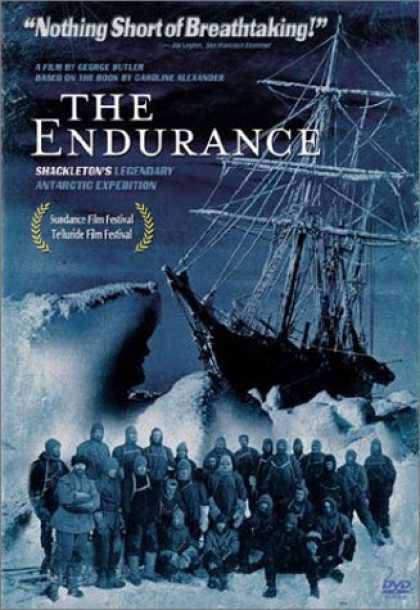
Ernst Shackleton's antarctic adventures: In January 1909 he and three companions made a southern march which established a record Farthest South latitude at 88°23'S, 97 geographical miles (114 statute miles, 190 km) from the South Pole, by far the closest convergence in exploration history up to that time. For this achievement, Shackleton was knighted by King Edward VII on his return home.

After the race to the South Pole ended in 1912 with Roald Amundsen's conquest, Shackleton turned his attention to what he said was the one remaining great object of Antarctic journeying—the crossing of the continent from sea to sea, via the pole. To this end he made preparations for what became the Imperial Trans-Antarctic Expedition, 1914–17. Disaster struck this expedition when its ship, Endurance, was trapped in pack ice and slowly crushed, before the shore parties could be landed. There followed a sequence of exploits, and an ultimate escape with no lives lost, that would eventually assure Shackleton's heroic status (via Wikipedia)

(via Boingboing)


So, in 1909 Shackleton aborted the attempt to reach the South Pole (no, he really just wanted to stop 200 kms outside the south pole). While there he abandoned two cases of scotch at base camp. A century later someone is digging it up.

Whyte & Mackay, the drinks group that now owns McKinlay and Co., has asked for a sample of the 100-year-old scotch for a series of tests that could decide whether to relaunch the now-defunct Scotch. Workers from New Zealand's Antarctic Heritage Trust will use special drills to reach the crates (a straw), frozen in Antarctic ice under the Nimrod Expedition hut near Cape Royds.

If you haven't seen the movie about this antarctic excursion, you really should. The Endurance came as a bit of a surprise, and after seeing it a few times (once just recently) it was really well done.


Here's the NyTimes review and Metacritic, with universal acclaim.

Sunday, November 22, 2009

So, why is yawning contagious?

What intrigues me most about laughter is how it spreads. It’s almost impossible not to laugh when everybody else is. There have been laughing epidemics, in which no one could stop and some even died in a prolonged fit. There are laughing churches and laugh therapies based on the healing power of laughter. The must-have toy of 1996—Tickle Me Elmo—laughed hysterically after being squeezed three times in a row. All of this because we love to laugh and can’t resist joining laughing around us. This is why comedy shows on television have laugh tracks and why theater audiences are sometimes sprinkled with “laugh plants”: people paid to produce raucous laughing at any joke that comes along.

The infectiousness of laughter even works across species.

...

Shared laughter is just one example of our primate sensitivity to others. Instead of being Robinson Crusoes sitting on separate islands, we’re all interconnected, both bodily and emotionally. This may be an odd thing to say in the West, with its tradition of individual freedom and liberty, but Homo sapiens is remarkably easily swayed in one emotional direction or another by its fellows.

This is precisely where empathy and sympathy start—not in the higher regions of imagination, or the ability to consciously reconstruct how we would feel if we were in someone else’s situation. It began much more simply, with the synchronization of bodies: running when others run, laughing when others laugh, crying when others cry, or yawning when others yawn. Most of us have reached the incredibly advanced stage at which we yawn even at the mere mention of yawning—as you may be doing right now!—but this is only after lots of face-to-face experience.

Yawn contagion, too, works across species. Virtually all animals show the peculiar “paroxystic respiratory cycle characterized by a standard cascade of movements over a five- to ten-second period,” which is the way the yawn has been defined. I once attended a lecture on involuntary pandiculation (the medical term for stretching and yawning) with slides of horses, lions, and monkeys—and soon the entire audience was pandiculating. Since it so easily triggers a chain reaction, the yawn reflex opens a window onto mood transmission, an essential part of empathy. This makes it all the more intriguing that chimpanzees yawn when they see others do so.

Yawn contagion reflects the power of unconscious synchrony, which is as deeply ingrained in us as in many other animals. Synchrony may be expressed in the copying of small body movements, such as a yawn, but also occurs on a larger scale, involving travel or movement. It is not hard to see its survival value. You’re in a flock of birds and one bird suddenly takes off. You have no time to figure out what’s going on: You take off at the same instant. Other­wise, you may be lunch.

Or your entire group becomes sleepy and settles down, so you too become sleepy. Mood contagion serves to coordinate activities, which is crucial for any traveling species (as most primates are). If my companions are feeding, I’d better do the same, because once they move off, my chance to forage will be gone. The individual who doesn’t stay in tune with what everyone else is doing will lose out like the traveler who doesn’t go to the restroom when the bus has stopped.

(via Discoverblogs)


Also, does susceptibility to others' yawning mean you're a nicer person (empathy and all.. )?

Ok, one more iphone app/board game: Settlers of Catan

I downloaded this last night, and have been geeking it out intermittently between sleeping, eating, and packing.


Here's a review of the iphone game, and here's a pretty good strategy site.

Basically, you can read the rules here, but in all honesty, I didn't understand the game until playing 4-5 times. Getting started, the game tutorial does help a bit as well.

Also, I think cuz the rules are built in very strict on the app, it's easier not to make stupid addition mistakes, placement mistakes, not seeing the big picture mistakes. I'm looking forward to playing with others to see how different it is..

The only downside to this app that I see is the multi-player; there's no wifi or bluetooth option, so that means you're gonna be passing the iphone around, which is bogus. Time to make a board over the Christmas holidays.

Saturday, November 21, 2009

Timelapse app for iphone

From JJ, this app is free for a few days.

http://philipbloom.co.uk/2009/11/21/itimelapse-app-for-your-iphone-yes-really/


Here's an example timelapse movie!


Also, the best iphone stand I've seen, made from a paperclip.

A Case for Working With Your Hands


http://www.nytimes.com/2009/05/24/magazine/24labor-t.html

When we praise people who do work that is straightforwardly useful, the praise often betrays an assumption that they had no other options.

We idealize them as the salt of the earth and emphasize the sacrifice for others their work may entail. Such sacrifice does indeed occur — the hazards faced by a lineman restoring power during a storm come to mind. But what if such work answers as well to a basic human need of the one who does it? I take this to be the suggestion of Marge Piercy’s poem “To Be of Use,” which concludes with the lines “the pitcher longs for water to carry/and a person for work that is real.” Beneath our gratitude for the lineman may rest envy.

...

There is a pervasive anxiety among parents that there is only one track to success for their children.

...

The trades suffer from low prestige, and I believe this is based on a simple mistake. Because the work is dirty, many people assume it is also stupid. This is not my experience.

...

There probably aren’t many jobs that can be reduced to rule-following and still be done well. But in many jobs there is an attempt to do just this, and the perversity of it may go unnoticed by those who design the work process ... Any given symptom may have several possible causes, and further, these causes may interact with one another and therefore be difficult to isolate. In deciding how to proceed, there often comes a point where you have to step back and get a larger gestalt. Have a cigarette and walk around the lift. The gap between theory and practice stretches out in front of you, and this is where it gets interesting. What you need now is the kind of judgment that arises only from experience; hunches rather than rules. For me, at least, there is more real thinking going on in the bike shop than there was in the think tank.

...

I once accidentally dropped a feeler gauge down into the crankcase of a Kawasaki Ninja that was practically brand new, while performing its first scheduled valve adjustment. I escaped a complete tear-down of the motor only through an operation that involved the use of a stethoscope, another pair of trusted hands and the sort of concentration we associate with a bomb squad. When finally I laid my fingers on that feeler gauge, I felt as if I had cheated death. I don’t remember ever feeling so alive as in the hours that followed.

Often as not, however, such crises do not end in redemption. Moments of elation are counterbalanced with failures, and these, too, are vivid, taking place right before your eyes. With stakes that are often high and immediate, the manual trades elicit heedful absorption in work. They are punctuated by moments of pleasure that take place against a darker backdrop: a keen awareness of catastrophe as an always-present possibility. The core experience is one of individual responsibility, supported by face-to-face interactions between tradesman and customer.

...........................................................................

Sometimes I really like my job for this reason. If I get bored in the office and feel the need to work with my hands, I can go down to the garage and observe, tinker, lend a (very novice) helping hand, hang out and learn the ins and outs of an isolated system being currently worked on (a gas pump failure, vehicle overheating, vacuum leaks, etc.). Beyond the learning, there is a certain immediate gratification with every small step you take while working with your hands. Whether it's drilling down a line of steel bolts, cutting up stainless steel at step 1 of a project, or suggesting a solution to a mechanical problem that hasn't yet been thought of because you're really just an outside eye; there is a certain immediate gratification that is not reached when pressing save and send on a spreadsheet. Then, I can go back into the office, sort of refreshed (perspective?), and continue at the desk doing desk stuff.

Writing invoices, preparing ad campaigns, researching tech, gathering/organizing statistical information, government bs, payroll, cheques, organizing schedules, preparing for operations, etc.; soft skills? There really isn't an immediate satisfaction. The variety is certainly there, but something is definitely not. Maybe, more specifically, it's an immediate recognition of your worth. I think that's part of the reason I like work road trips so much. At the end of the trip I know exactly how much I made and saved the company. Granted I spend 95% of my time at the desk, but if it wasn't for that 5% in the garage and on the road, I most certainly wouldn't still be at the PHD Group.